
And if the supply converted to hydrogen?
Hydrogen has its place in the carbon-free transport sector.
A little chemistry to start. Hydrogen (H2) is a gas that can be produced by electrolysis, that is, by breaking water molecules with electricity. And this without any emissions. We speak of green hydrogen if the electricity used comes from renewable resources.
It is mainly used today as a raw material in chemistry to produce fertilizers and in metallurgy.
It has recently appeared in the world of energy and transportation. In fact, its combustion generates approximately 3 times more energy than diesel, without emissions of harmful gases. The only reaction product that makes it possible to produce electricity from hydrogen is water vapor!
The transport sector is responsible for approximately 20% of global greenhouse gas emissions. Hydrogen is therefore positioned as an excellent substitute for the intensive use of fossil fuels to achieve the emissions reduction targets set by Europe.
In practice, for vehicles, hydrogen offers a use similar to fossil fuels: autonomy, refueling time and vehicle performance remain unchanged. And that, without emissions: neither NOx nor CO2. If the hydrogen used is green, then the cycle is completely environmentally friendly.
This green solution can therefore be used to power almost all means of transport used in supply chain : forklifts, city delivery vehicles, heavy goods vehicles, trains and even boats. Hydrogen vehicles are already available on a pre-commercial or commercial scale for each of these uses. But the sector, in particular for supply chain, does not take off at the expected pace.
But then what are the obstacles to the massive use of hydrogen in supply chain ?
First element of response: the cost.
Hydrogen solutions are currently more expensive than their carbon equivalents. But the reduction in costs has already begun and will accelerate with the increase in volumes and the scaling up of means of production (industrialization of electrolysis processes and mass production of systems). A recent report from Shell estimates that by 2030, the overall cost of using a hydrogen heavy-duty truck will be equivalent to that of a diesel heavy-duty truck.[i]
Second element of response: the availabilityinfrastructure.
For the use of hydrogen to become more widespread, hydrogen distribution stations must cover the entire territory like conventional solutions. This is all the more crucial for vehicles traveling long distances, as is the case in logistics. But the infrastructure is still struggling to develop, because the existing distribution of hydrogen (used in chemistry in particular) is not adapted to these new “general public” uses.
Indeed, currently hydrogen is transported and stored either in its gaseous form at high pressure (200 to 500 bars) or in its liquefied form at very low temperature (-253°C). These transport technologies require the use of dedicated infrastructures which are expensive to deploy and maintain. For example, a hydrogen transport truck costs almost 10 times more than a diesel transport truck.[i].
Due to the nature of hydrogen, these solutions are subject to strict safety rules. For example, we cannot store more than a ton of hydrogen in city centers without authorization (ICPE 4715[ii]).
This limited capacity, these dedicated infrastructures and subject to restrictive regulations obviously have a negative impact on the cost of distribution. Today, the transport of hydrogen corresponds to approximately 30% of the cost for the end user[iii].
There supply chain is therefore waiting for a hydrogen distribution solution that is easy to implement, economical, safe and of course sustainable. It is the missing link to democratize hydrogen in the supply chain.
Liquid hydrogen vectors, the keystone of hydrogen distribution for use in logistics
The good news is that innovative solutions are being developed to overcome the limitations of traditional technologies: liquid hydrogen vectors.
These innovations, in addition to facilitating the transport of hydrogen, make it possible to use already existing liquid storage and transport infrastructures for fossil fuels (tanker truck, storage depot, etc.).
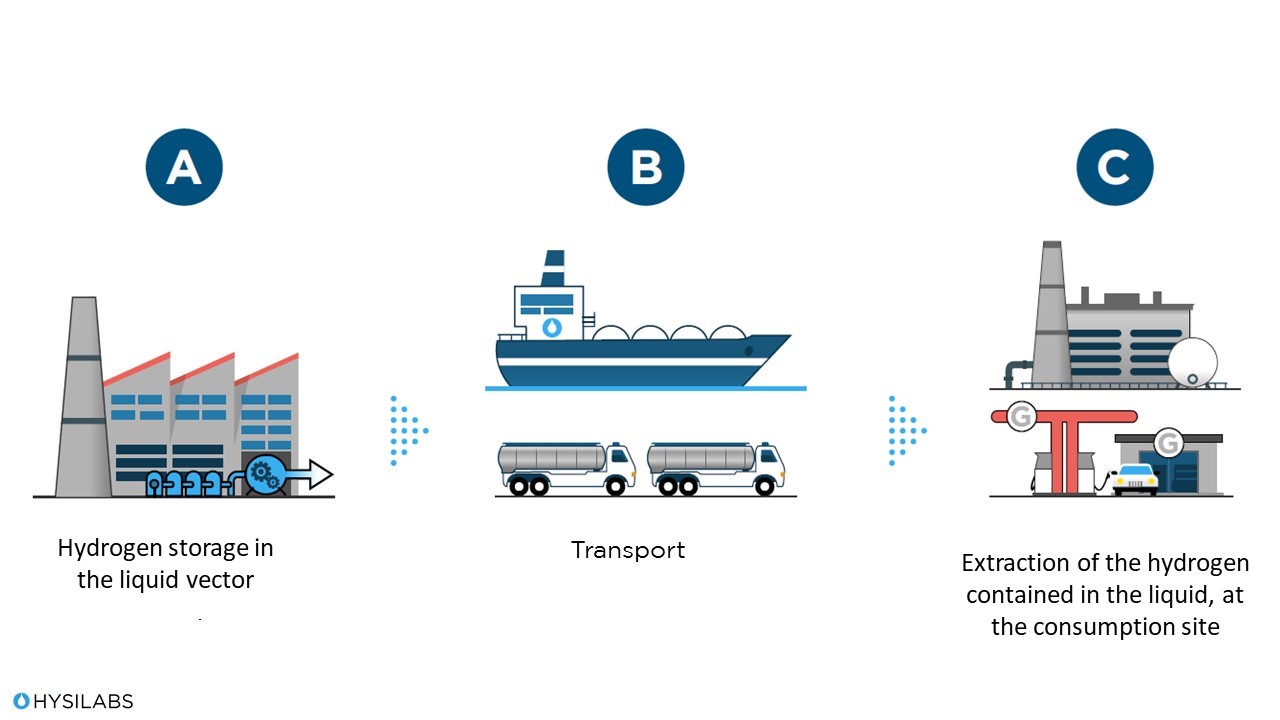
Concretely, the hydrogen produced by electrolysis is directly stored in the liquid via a chemical reaction (step A). The liquid thus charged with hydrogen is easily transported to the service station (step B). It can be stored safely on site. Finally, the hydrogen is released on demand as needed (step C). The discharged liquid can then be charged with hydrogen again (hence the term vector).
Several types of liquids have been developed, and are compared according to the following criteria:
- Storage performance: how much hydrogen can be stored in 1 liter of vector?
- Environmental impact: what are the emissions associated with the production and use of this liquid?
- Safety: Is the liquid dangerous, toxic or flammable?
- Cost: what is the price per kg of hydrogen transported?
Each liquid has advantages and disadvantages, such as ammonia or toluene, which have very good storage performance but remain toxic or carbon elements. It will therefore be necessary to find a compromise between cost, performance, safety and environmental impact.
On the French technology side, the startup HySiLabs (of which the authors of this article are part) has developed one of these liquid vectors of the future: HydroSil. This liquid vector developed in Aix-en-Provence presents interesting storage performances for different applications. In fact, a simple HydroSil tanker truck will transport up to 7 times more hydrogen than a high-pressure truck. This gain therefore directly impacts the cost of transport (which can be reduced by at least 50% compared to transport in the form of high pressure gas) while offering a safer solution which is fully compliant with the environment (non-toxic and non-carbon).
By simplifying hydrogen logistics, these liquids therefore represent a real solution for the transport, storage and use of hydrogen in sectors where it is still used too little. They are the missing links that will allow hydrogen to fully play its role in the energy transition of supply chain.
[i] Paul Bogers, VP Shell Hydrogen during the Plug'n Play Webinar on the 27/10/2020
[i] IEA, 'The Future of Hydrogen', June 2019
[ii] https://aida.ineris.fr/consultation_document/30090, website consulted on 10/30/2020
[iii] According to information collected from hydrogen players: for 1kg of hydrogen $2 for production, $6 transport/storage and $8 for infrastructure linked to service stations. In comparison, transport/storage represents between 0.015 and 0.02 € for 1 L of fuel.
To know more : www.hysilabs.com
Read all the “Expert Opinion” articles on the SprintProject blog


