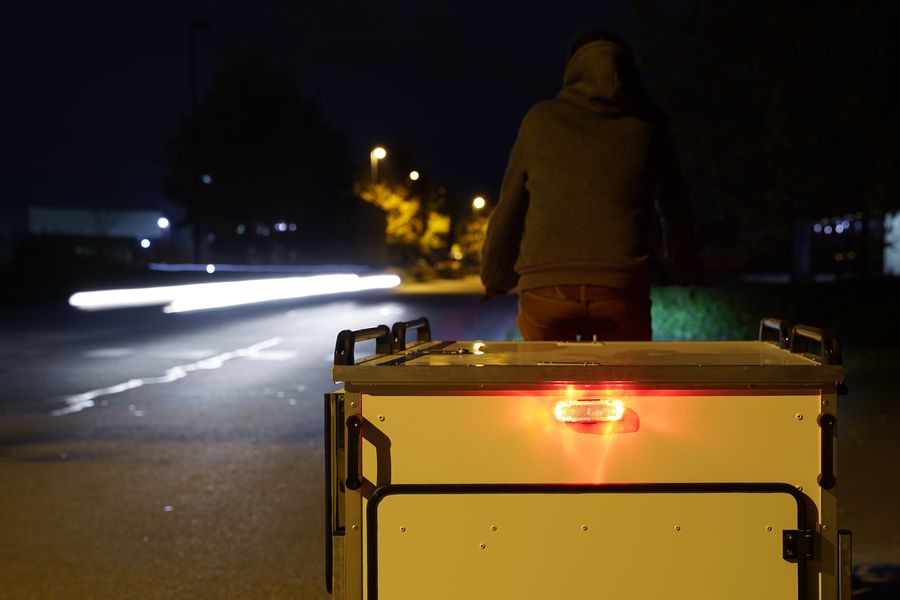
Urban logistics has become, in just a few years, an extraordinary engine for the development of commerce and more particularly that of e-commerce. This strong development was able to be achieved, in part, with the operational means of the time (for almost 20 years already!), that is to say the light utility vehicle, diesel fuel.
The advent of this explosion is today (or more precisely for several years now) in contradiction with other desirable and desired societal conditions, particularly environmental ones. The end of “all oil” has arrived! It now requires us to reinvent our means of transport and organization for all logistics flows, whether they are handled personally or on behalf of others. In this diagram, cyclo-logistics and professional cyclomobility take on all their meanings: economical, ecological, friendly... on condition that we also rethink our paradigms and our organizations. In this new dynamic of development, Toutenvélo has been a concrete example for more than 10 years.
Toutenvélo, carbon-free “public” transport

Toutenvélo is a network of cooperative companies dedicated to urban logistics. Operating throughout mainland France (for the moment...), these employee-owned cooperative and participative companies offer comprehensive logistics services. These activities mainly respond to the management of goods flows in urban centers; ranging from storage, to rapid delivery, including removals and subcontracting of parcel distribution on behalf of national and international logisticians. These transport capacities are translated into the famous slogan “from 0 to 300 kg”. Since 2021, the Toutenvélo companies have formed a collective structure (SCIC) that could be described as a network head. The main activities of this new company are to meet the needs of the network and provide the rolling stock necessary for cycle logistics and professional cycle mobility. Toutenvélo therefore controls the entire chain with logistics services and the supply (and manufacturing) of suitable cargo bikes.
The end of “all diesel”, an opportunity to reinvent our logistics organizations

Environmental constraints play a major role in the need to rethink some of our organizations. Thus in our metropolises, transport is responsible for numerous negative externalities for the populations who live there. This is today one of the main reasons for the development of soft mobility. In this inventory of new means of transport, we find the electric vehicle, the hybrid, the bicycle, the scooter, the single-wheel and other gyropods. Everyone at their own level provides a solution to the given constraints. Some provide a partial answer, such as electric or hybrid vehicles, which do not remove non-exhaust particulate matter (PHE – emanating from brakes and tires) or congestion. Others are only involved in the transport of people, without being able to carry a large load. Finally, the bicycle or more precisely the cargo bike can, within a certain limit, of course, ensure wider and more consistent use while meeting traffic and emissions constraints.
The cargo bike or utility bike: a light and agile vehicle for the needs of professionals

Longtail, two-wheeler, three-wheeler, tricycle, bicycle-trailer... are concrete answers to better experience our city centers. From craftsmen to traveling restaurateurs and logisticians, they all have specific needs that the cargo bike can address. Technology has made it possible to modernize an old concept from the early 1900s, the three-wheeler, a cycle dedicated to transporting loads. Today, it is easy to find a solution adapted to the specific needs of many activities. For example, Toutenvélo develops and designs a wide range of bicycle trailers suitable for the professions of landscaper, plumber, electrician, painter, multi-service, waste collector, traveling restaurant owner, trader... Less expensive to buy and maintain than a heavier vehicle, they are making a comeback for tradesmen caught up in the constraints of urban traffic. These new vehicles make it possible to reduce the intervention costs of a craftsman by reducing the approach and search times for parking (not to mention the risk of fines). Increased profitability, great responsiveness and an improved image can only be achieved by using a means of transport adapted to today's requirements: the cargo bike. But be careful, by transposing operations using “diesel” to cargo bikes, companies often forget that the professions and practices are not equivalent.
Half-cargo, half-LCV, the intermediate vehicle, in the wheel of the cargo bike
In the relatively binary landscape presented (light utility vehicle/cargo bicycle), a third voice emerges, that of an intermediate vehicle that is half bicycle, half LCV. With three or four wheels, with motorized assistance greater than 250 Watts of nominal power, an electric transmission, a trigger rather than pedals to move forward... each manufacturer uses its own breakthrough technology. However, at this stage, these vehicles fall into a legal and regulatory void. Beyond this proven risk, these “overruns” will very logically lead manufacturers to do more in order to differentiate themselves from competing products. So, now that the observation of a finite world is accepted by a majority of the population, should we seize this opportune circumstance to improve daily life, or slow it down so as not to fall into “always more”?
The cargo bike, at the head of the pack of new vehicles
In any case, behind this somewhat philosophical question which I will let you answer, the cargo bike remains and will remain:
- a means of transpolitical transport with strong empathetic capital,
- a more economical product than heavier vehicles,
- a transport tool with a reduced impact, both for its manufacture and its use,
- a low-tech and efficient approach to transporting loads,
- a modular solution which corresponds to many use cases and professions,
- a relevant response to calm our city centers.
In short, there are numerous arguments for the cargo bike to still fit anywhere in the city of today and tomorrow. With the creation of the economic bicycle sector, dedicated industrial clusters, user associations such as the Boîtes à Vélo, the FUB and the latest one, the Professional Cyclo-logistics Federation, the change of scale is already underway. Everything is in place so that the years to come will be synonymous with significant growth in usage.

In any case, at Toutenvélo, we are convinced of this and are actively working to present you with the solutions best suited to your needs! Do not hesitate to have a look : https://velocargo.toutenvelo.fr/.
Read all the « Expert Opinion » articles on the SprintProject blog


